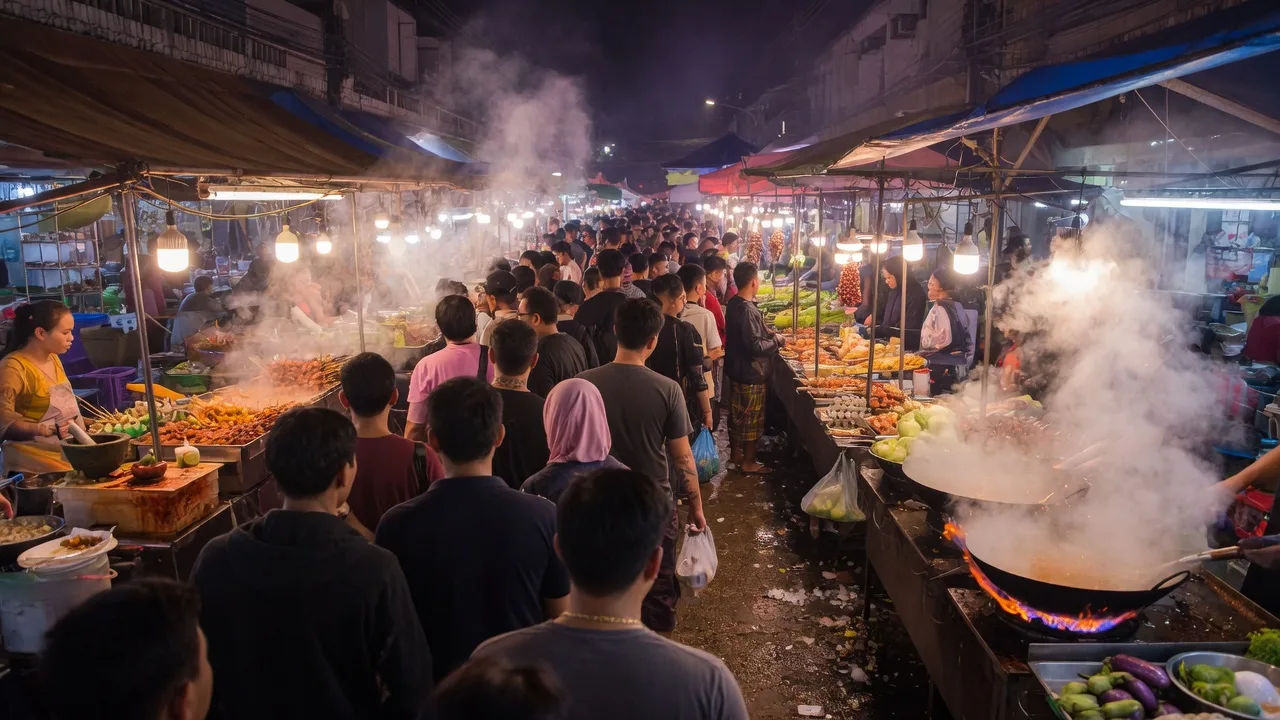
Thai “vegetable” dishes often start with fish sauce (nam pla) or shrimp paste (kapi). Green curry with tofu is not vegan by default. Morning glory is often fried with oyster sauce. If you only say “vegetarian” in English, you will collect hidden fish and a smile. The smile is kreng jai. The fish is still in the wok.
The hidden fish problem
Three overlapping words do different jobs. Mixing them up is how you eat kapi and call it a win.
Mangsawirat (มังสวิรัติ) — vegetarian in the broad Thai-Chinese sense. Often still allows egg and dairy. Sometimes still allows fish sauce, depending on the cook and the decade. It is the word restaurants put on a sign. It is not a vegan contract.
Jeh / jay (เจ) — strict vegetarian in the Chinese-Buddhist / festival sense. No meat, no fish, no stock from those, and classically no garlic, onion, or strong aromatics. Yellow flags in the Vegetarian Festival mark this kitchen. It is the strictest common street label. It is also a religious category, not a supermarket lifestyle.
Phak / “veg only” in English — almost useless on its own. Pad phak can still be oyster sauce and fish sauce. Point at ingredients. Use the phrases below.
The trap list, because it is always the same traps:
- Fish sauce in stir-fries, salads, soups, “vegetable” fried rice.
- Shrimp paste in curry pastes and nam prik.
- Oyster sauce on morning glory and mixed veg.
- Dried shrimp in som tam thai.
- Egg, if you are vegan, in fried rice and in “vegetarian” fried rice.
- Fish sauce on the condiment tray (prik nam pla) even when the wok was clean. Chilli and condiments.
What to say (and what to point at)
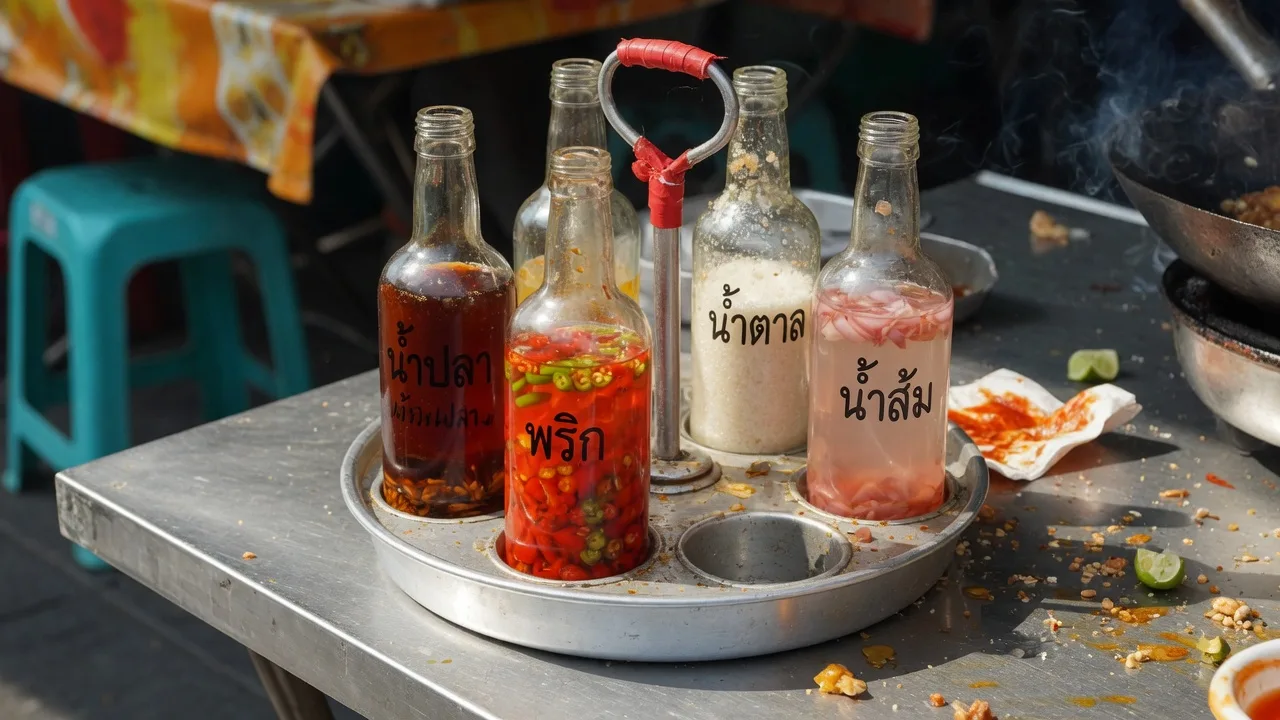
Carry the lines on your phone. Point. Do not rely on a tired 22:00 transliteration from memory.
| English intent | Thai (say / show) | What it usually gets you | Watch for |
|---|---|---|---|
| Vegetarian (broad) | Mangsawirat / มังสวิรัติ | Veg restaurant, egg likely OK | Fish sauce still possible |
| Strict / festival veg | Jeh / เจ | No meat, no fish, often no garlic/onion | Not every stall knows the word |
| No fish sauce | Mai sai nam pla / ไม่ใส่น้ำปลา | The main trap named | They may use soy; confirm |
| No shrimp paste | Mai sai kapi / ไม่ใส่กะปิ | Curry paste and nam prik trap | Paste may already be made |
| No oyster sauce | Mai sai nam man hoi | Morning glory trap | They may look puzzled; point |
| No egg (vegan) | Mai sai khai / ไม่ใส่ไข่ | Fried rice, pad thai | Fish sauce still independent |
| No dried shrimp | Mai sai kung haeng | Som tam | Crab / fish sauce still there |
| I cannot eat any animal | Combine jeh + the mai sai lines | Best shot on the street | A dedicated veg shop is easier |
A dedicated mangsawirat or jeh restaurant in Bangkok or Chiang Mai is still the high-percentage play. Indian-Thai and Chinese-Thai vegetarian rooms exist for a reason. Street som tam with tofu is possible if they skip crab, dried shrimp, and fish sauce — not every stall will. If they hesitate, do not bully them into a chemistry experiment in a mortar they use for shrimp. Walk.
Safe-ish bets when you cannot decode a wok:
- Fruit. Peeled. Market and 7-Eleven cups.
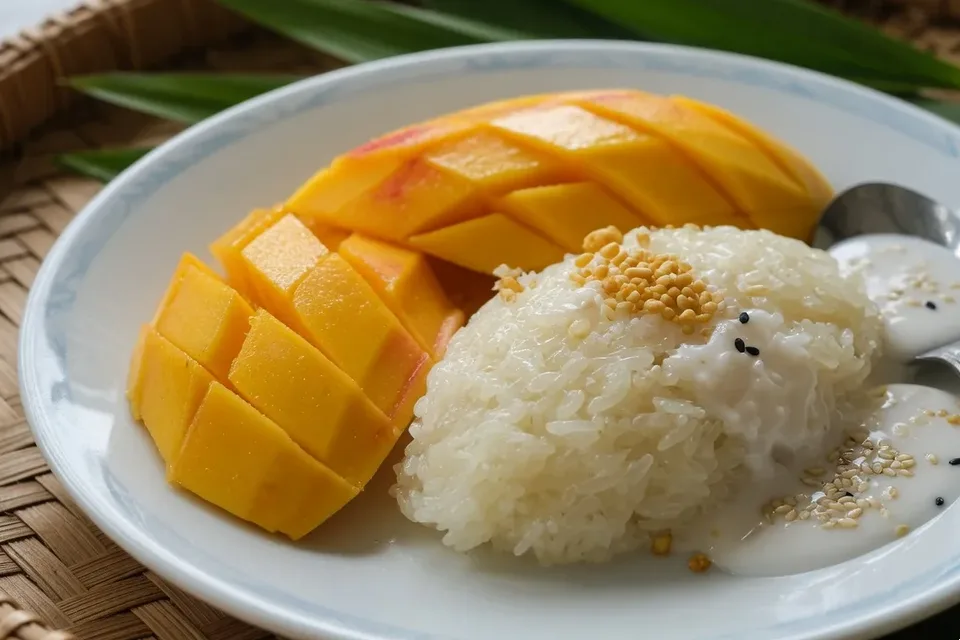
- Coconut ice cream; mango sticky rice — ask that the sticky rice is coconut milk only.
- Khao pad jay in a shop that actually uses the word jay.
- Rice and plain veg at a jeh stall during festival weeks.
- 7-Eleven: fruit cups, some labelled salads — read the sticker. Rice boxes are usually meat. 7-Eleven meals.
Cooking classes: ask for a vegetarian class in advance. Pastes can be made without shrimp. Cooking classes. A granite mortar at home is how you repeat som tam without the stall’s default shrimp — that is a later hobby, not tonight’s dinner. Granite listings are size menus, and fish sauce is the wrong product here, so this stays a search.
Festival yellow, and the rest of the year
The Vegetarian Festival (especially Phuket, ninth lunar month) is the easiest week of the year to eat jeh. Yellow flags mark stalls. The food is a cuisine, not a punishment: mock meats, soy, fried things, sweets. It is also crowded and loud and not a quiet vegan brunch. Dates move with the lunar calendar — check a current sheet; we will not invent a fake weekday. People & Spirit’s Thai calendar is the logic; the flag is the signal.
The rest of the year, jeh shops still exist in cities with Chinese-Thai populations. They are ordinary lunch rooms. They are not always labelled in English. Look for เจ, for yellow, for a tray of already-cooked veg that is not sitting in fish sauce.
Isan sticky-rice culture is meat-and-fish heavy. You can eat there as a vegetarian. You will work harder. Central Thai rice-and-curry shops with a veg tray are easier if you can name nam pla. Southern curries are shrimp-paste country; do not take a smile as a reformulation.
How to not make it a scene
Be specific. Be brief. Do not deliver a TED talk on veganism at a 40-baht stall. The social technology of not imposing is Kreng jai; the practical technology is a phrase on a screen.
If they cannot do it, thank them and leave. A stall that only makes one dish with kapi is not going to invent a second kitchen because your ethics arrived. The next sois may have a jeh shop that has been doing this since before you had the word vegan.
Hotel breakfasts: fruit, rice, the egg question. Buffet “veg” stir-fry is often the oyster-sauce problem again. The fruit platter is honest.
You can eat well in Thailand without fish. You cannot do it on English adjectives alone. Use the Thai words, accept egg if mangsawirat is enough, step up to jeh if it is not, and treat every curry paste as guilty until the mortar proves otherwise.
Next
How to order, Chilli and condiments, Street food, Cooking classes.