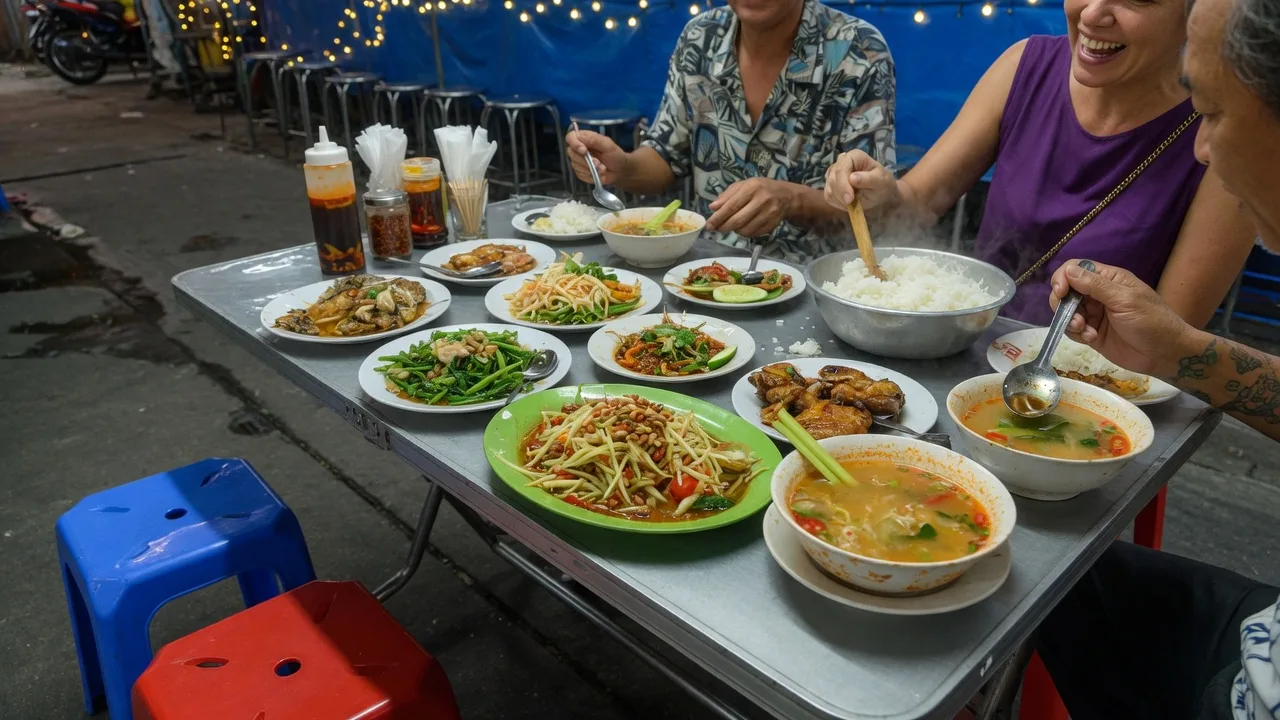
Thai meals are built around rice (khao), not around a single “main” the size of a British dinner plate. Order rice, then dishes to share. Noodles are usually a one-person meal, not the shared table. Get that split right and the rest is portion maths, mai phet, and one bill.
Rice is the centre
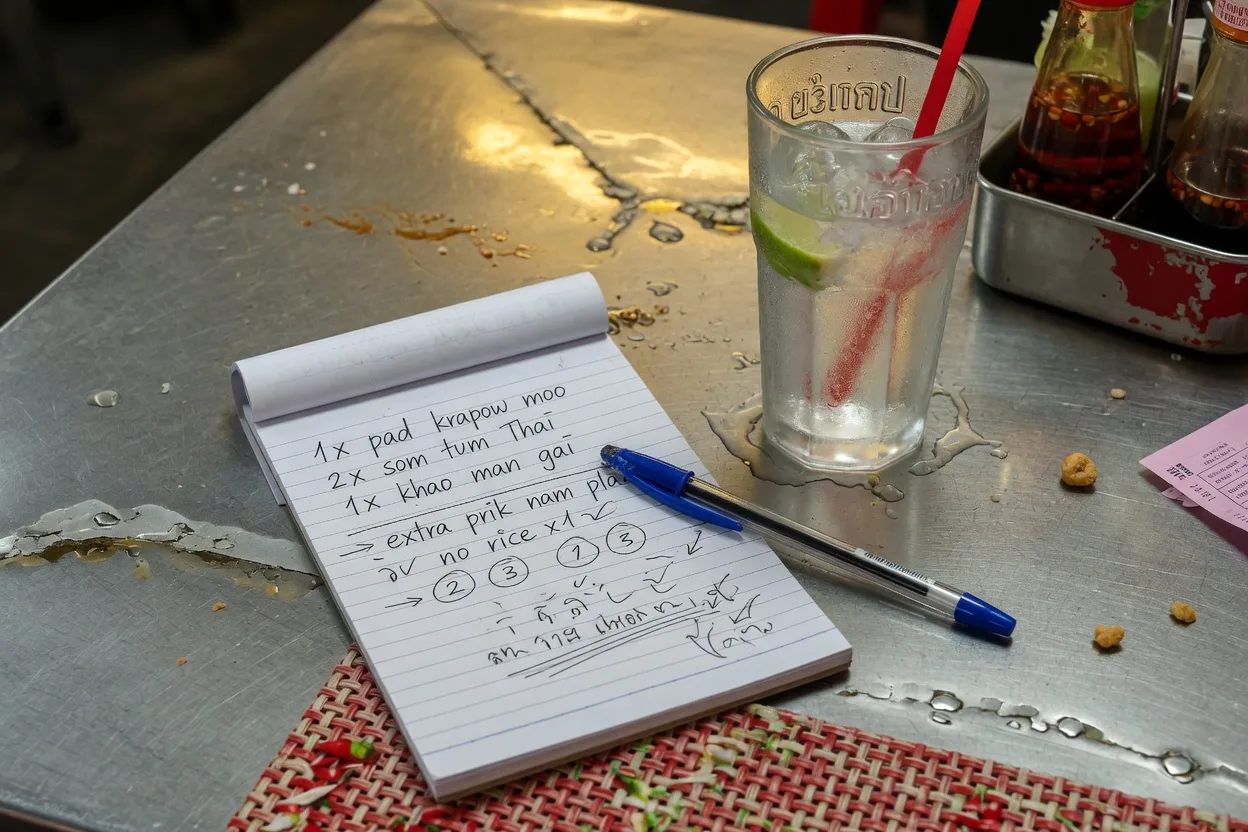
Steamed jasmine rice for central and southern tables. Sticky rice (khao niao) for Isan and Lanna, eaten with the hand, with som tam and grilled chicken. Mixing those without noticing is how a table feels slightly wrong even when the food is good.
A working order of battle for a shared table:
- Rice — enough bowls or a basket of sticky rice. This is not a side.
- One soup or curry — tom yum, gaeng keow wan, gaeng som, a coconut curry if the table wants soft.
- One stir-fry — morning glory, pad krapow, mixed vegetables.
- One salad or grilled — som tam, larb, gai yang.
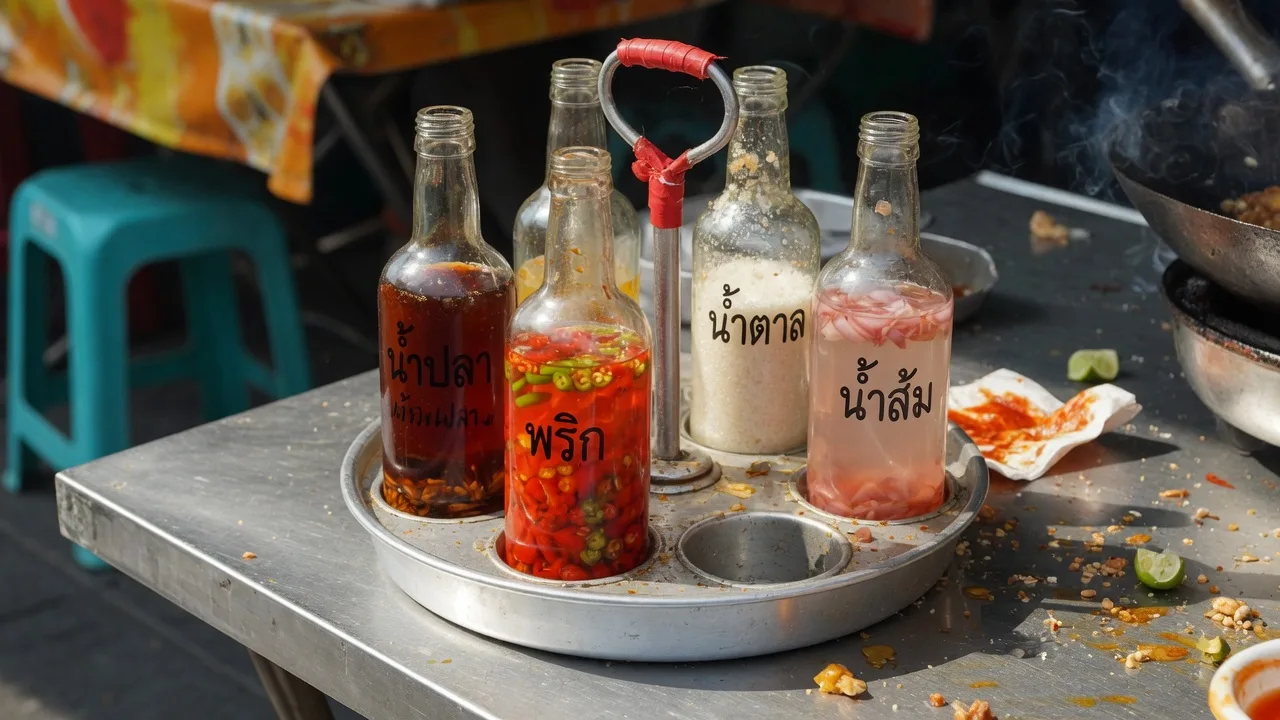
- The condiment caddy — fish sauce chilli, flakes, sugar, vinegar. You finish the seasoning. Chilli and condiments.
That is lunch or dinner for two once the portions are Thai-sized. It is not five British mains. Leftovers are normal. Taking them is normal.
Noodles (pad thai, boat noodles, kuay tiao) are the exception: one bowl, one person, often eaten at the stall without sharing. You can sit together and each have noodles. You do not order one pad thai and four forks unless you like arguing about the last shrimp.
Rice-and-curry shops (ran khao gaeng) are the solo lunch that tourists walk past. Trays of already-cooked curries, stir-fries, and stews. You point at two or three, they go on rice, you sit. That is a complete Thai meal for one without assembling a shared table. Prices sit in street territory, not 7-Eleven territory and not hotel territory.
Night markets: point, smile, pay when the bag is handed over. Sit if there are stools. Night markets and street food. Do not order eight bags “to share later” from a grill that cooks to the stick in front of you; eat them hot. The bag that sits in a hotel fridge for three hours is not the dish.
Granite mortar listings are size menus, so the mortar stays a name. The stall already pounded; you season. At home the pantry buy is Squid Brand fish sauce, 725 ml, one bottle. A smaller bottle is a different listing. You still need to say how hot, and whether the dried shrimp stays in if you do not eat fish. Vegetarian.
Portion maths
| People | Shared table | Noodle shop | Notes |
|---|---|---|---|
| 1 | One rice + one stir-fry, or a curry-over-rice shop plate | One bowl | Ran khao gaeng (rice-and-curry by the scoop) is the solo hero |
| 2 | Rice + three dishes (soup/curry, stir-fry, salad or grill) | Two bowls | Add a fourth if one is a light veg |
| 3 | Rice + four dishes | Three bowls | Keep one of them a soup |
| 4 | Rice + five or six | Four bowls | Leftovers expected; not a failure |
Tourist restaurants will try to sell you one “main” each plus rice each plus a “starter”. That is a different cuisine wearing Thai words. If you wanted the Thai table, push back toward shared plates. If you wanted a steak, order the steak and stop making it the stall’s problem.
Spice. Cooks season for a Thai table. Say mai phet if you need it milder; phet nit noi for a little. Add heat yourself from the caddy. Do not perform “very spicy” as a personality unless you mean it — Isan will believe you. The tray is still there for the rest of the table.
Vegetarian. Name fish sauce and shrimp paste. Tofu is not a certificate. Phrase table: Vegetarian and vegan.
Paying, sharing, not making a scene
One bill is typical. No elaborate split at a street table. Round up if you sat a long time in air-con. Stalls: pay the posted or spoken price; do not invent a London percentage. Sit-down rooms: a small round-up is fine. The FAQ on this site will say the same thing in shorter form.
Pointing at a tray of already-cooked curries is a complete sentence. So is holding up two fingers for two rice. English works in tourist belts and fails at the stall that has been perfecting one soup since before you were born. A smile and a point is not colonial; it is lunch.
Do not rearrange the table into “this is my plate, that is yours” unless you have a medical reason. Shared dishes sit in the middle. Your rice is yours. Spoons go communal; the serving spoon, if it exists, is not your soup spoon.
If something is wrong — genuinely wrong, not “I wanted it hotter” — take it quietly to the person who cooked it. Volume plus an audience is a face problem. Kreng jai. The caddy already exists for heat.
7-Eleven when the stall is shut: rice boxes commonly 45–69 THB, Mama 15–30. That is a different meal class and a valid one. 7-Eleven meals. Beer hours in shops are 11:00–14:00 and 17:00–midnight; holy days dry. Thai Beer.
A sequence you can reuse
- Sit. Wait to be nodded at if it is a shop with a person who seats you. Street stool: sit.
- Rice first, in the head if not yet in the mouth.
- Shared dishes if you are two or more; bowls if you are in a noodle shop.
- Spice words once, clearly.
- Caddy after you have tasted, not before.
- One bill. Thank them. Leave the stools as you found them.
The first week’s first market night on Gateway is First week. This page is the table manners of the cuisine, not the city map. Order rice. Share the rest. Eat the noodles alone in the best sense.
Next
Street food, Chilli and condiments, 7-Eleven meals, Vegetarian, Night markets.